 Skip to main content

Grid project aims to power community energy change
Providing smarter and fairer grid connections for community energy groups at lower costs is the aim of a new innovation project.
Geoprint for Energy Club Connections and Operations (GECCO) seeks to unlock long-term benefits for communities by creating a connection that’s exclusively available for community energy groups, enabling local balancing and lower bills.
It will test a new “Geoprint” approach to identify the best points for linking local generation and demand collectively. This will cut connection costs and support communities to form “energy clubs”, which match local energy generation with local demand.
GECCO builds on Innovate UK’s £104 million Prospering from the Energy Revolution programme which funded 80 smart local energy system (SLES) projects. The idea is a Geoprint connection will enable connections for community energy groups willing to operate in a SLES and that groups will retain the benefits of doing so locally.
The project will help communities play their part in the clean energy transition by creating an evidence base to tackle existing national policy and regulatory hurdles and how they are applied at a local level.
For example, currently community energy groups generating electricity may sell to a supplier which will sell it back to customers at two to three times the original price. By connecting SLES, bill savings for demand customers and greater income for local generators can be achieved.
It is also anticipated the capability to offer connections to SLES rather than to a single generator will unlock new benefits to National Grid’s DSO, and to the network from flexibility and demand-side responses.
There are 170 community energy groups within our region and the sector is set to expand as the government’s Local Power Plan has an aspiration for more than 1,000 community-owned generation projects by 2030. Around 2 GW of this is expected to be installed in our licence areas.
Innovation Engineer Rois Smith said: “GECCO seeks to understand whether there is a better way for us to connect and manage community energy groups on DNO networks.
“It aims to address the struggles community energy groups can have getting a grid connection - which sometimes isn’t economically viable for them due to network constraints - as well as the long-term financial stability issues they are facing due to regulatory frameworks.
“GECCO’s ambitions align with national net-zero goals and the imminent Local Power Plan. What we learn from GECCO will also expand the potential for smart local energy markets to accelerate connections more widely.”
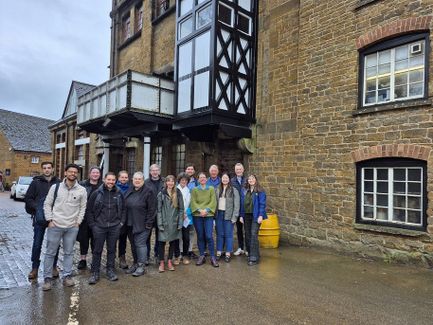
We are is working with TNEI, Regen, Energy Local and three community energy groups, including Hook Norton in Oxfordshire to test the Geoprint connection methodology and to assess its cost benefits.
Last year Hook Norton launched Energy Local North Oxfordshire which has 30 households and two businesses as demand customers, who are incentivised to match their electricity usage to a nearby solar farm.
Energy Local North Oxfordshire plans to expand to 120 domestic and six business demand customers, leading to a 44% increase in matching with the solar farm. It also wants to diversify its generation portfolio, to make it easier for demand customers to use electricity when it is local, but is struggling get a connection to the distribution network.
Before GECCO could be rolled out, we would need to seek a change to our licence condition to enable us to treat community energy groups differently from other customers.
- Innovation