 Skip to main content

Upper Ogmore Wind Farm Public Consultation
Cliciwch yma i weld y wybodaeth yn y Gymraeg.
We’ve now submitted our Development of National Significance (DNS) application for a new grid connection to connect the Upper Ogmore Wind Farm to our electricity distribution network in Wales.
If approved by Planning Environment Decisions Wales (PEDW, the Planning Authority for Wales), the new connection in the Upper Ogmore, Garw and Llynfi Valleys of Bridgend and Neath, Port Talbot, would connect the new Upper Ogmore Wind Farm to our network at a point close to the site of the consented Foel Trawsnant Wind Farm. To power the new wind farm, 9kms (5.6 miles) of new 66kV electricity cable would be installed, including 4.1kms (2.5 miles) of overhead power lines (OHL) carried by wooden poles and 4.9kms (3 miles) of underground cables (UGC).
Located in the Garw and Ogmore valleys, the Upper Ogmore Wind Farm will use seven turbines to generate 25MW of renewable energy a year - enough to power around 16,500 homes. The Upper Ogmore wind farm was approved by Welsh Government in 2022.
Our completed planning application will be available to view on the PEDW website when they are satisfied that our application meets all of their requirements. However, you can still view our consultation materials in our document library.
The Proposals
If approved, the connection route would be made up of both overhead lines to be situated on wooden poles and underground cables which would lie partially across the Neath Port Talbot and Bridgend Borders, starting and finishing in the area covered by Bridgend County Borough Council.
The nature of the works means that there would be no full road closures. Where a closure of part of the road is needed, traffic management and traffic lights would be in place for the duration of the works. We would work with the highways authorities to schedule and minimise the disruption of these works.
The proposed route would start from the proposed Foel Trawsnant grid connection to the northwest of Natyffyllon and would proceed to the Upper Ogmore Wind Farm, as follows:
- Beginning west of the A4063, near Caerau, with a ‘T’ Off connection from the Foel Trawsnant Grid Connection, as an OHL for approximately 1.1km (half a mile).
- As the route reaches Caerau, it transitions into UGC following the existing highway network for approximately 1.7km (1 mile) to the north.
- Immediately before reaching Brynheulog Road, the route goes back to OHL for approximately 3km (2 miles) to the east.
- To the west of Clawdd Mawr Dyke, the route transitions back to UGC and continues east for 3.2km (2 miles) towards the substation at the Upper Ogmore wind farm. During this part of the route, it would travel partially through the common of Mynydd Llangeinor.
What’s happening now?
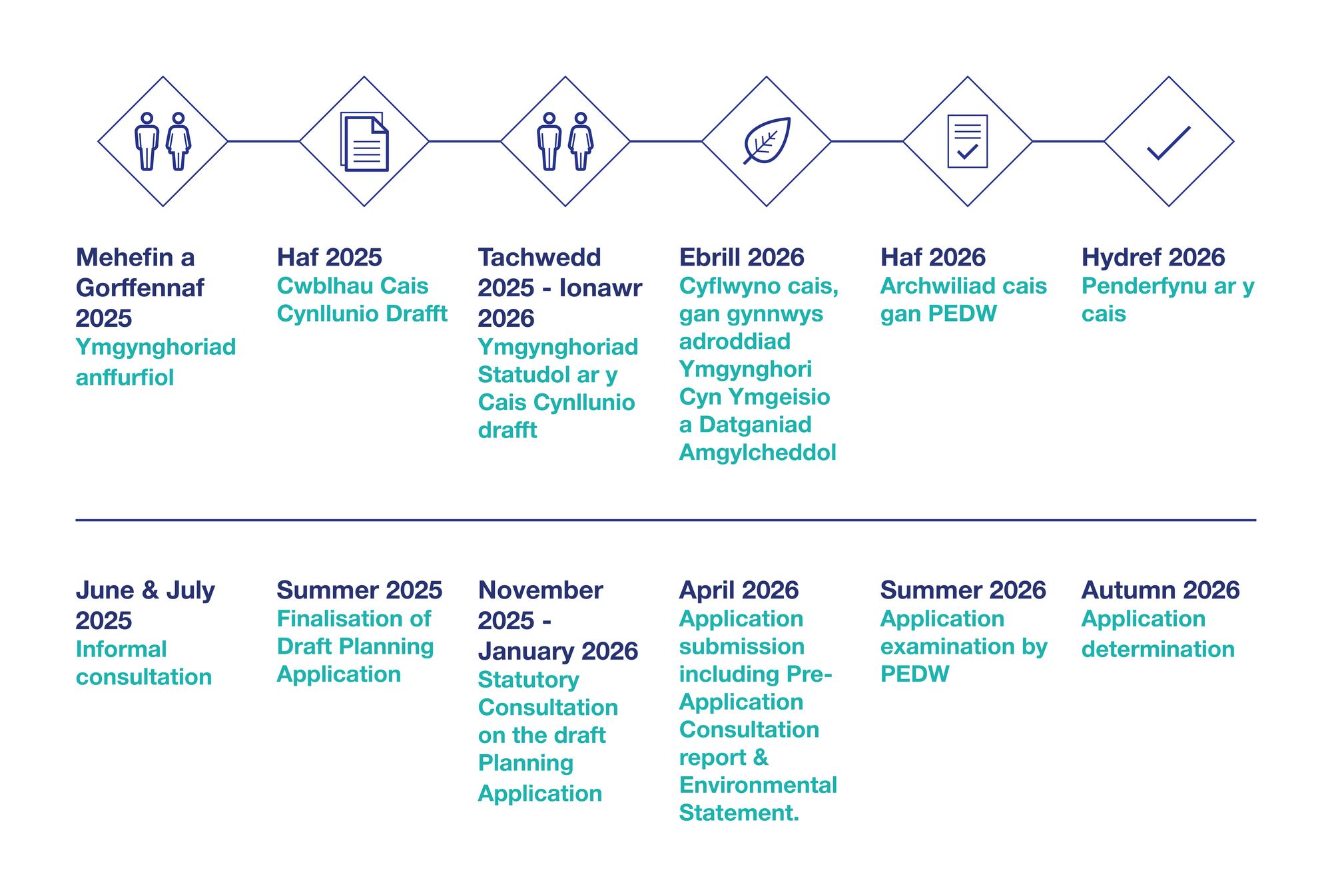
We submitted our application to PEDW in April 2026. Once PEDW have validated our application – i.e. that they are satisfied that our application meets all of their requirements - they will run a 5 week consultation on the proposals. During this time representations must be made directly to PEDW, and representations received by the Project Team will not be considered a part of the PEDW feedback process. ]
PEDW will then examine our application, conducting hearings about the scheme if necessary, before making a recommendation on a decision for the scheme. Whilst we would expect this process to take around six months, this is completely within the hands of PEDW and may take longer or shorter.
We anticipate that construction would begin in Summer 2028 and end in Spring 2029, with the line being energised and ready to transmit power at that time, allowing it to transport homegrown energy to the grid and strengthen our energy security.
Get in touch
You can contact us in the following ways:
- Telephone: 01656 334 319
- Email: nged.upperogmore@nationalgrid.co.uk
- Post: Freepost GRASSHOPPER CONSULT (no stamp or further address needed) The above contact details will put you in touch with Grasshopper Communications which is supporting us with the consultation.
The above contact details will put you in touch with Grasshopper Communications who are managing the consultation on behalf of National Grid Electricity Distribution.
Your questions answered
What impacts would there be on the local community?
If approved, as a part of the construction, there would be impacts on the roads between Croeserw and Duffryn as we construct the underground portion of the line. The works would only need to take place on a single side of the road and therefore, with traffic lights, we would be able to make sure everyone could get to where they need to be.
Would the power be used locally?
Power from the wind farm will be exported to the substation in Pyle. When electricity is produced by renewable sources such as wind, it is typically used closest to where it is generated first. This might be by nearby homes and businesses, or by other customers connected to the local network. When there is more electricity than can be used locally is it exported further afield.
What’s prevented you from connecting into the existing Caerau substation?
The existing Caerau substation does not have the capacity to accommodate the Upper Ogmore grid connection. If we were to connect this project into the Caerau substation, the works would be far more extensive and disruptive. Additionally, by building this new grid connection, we are future-proofing the network’s capacity.
Where can I find more information about the Foel Trawsnant Grid Connection?
More information on this project, which is being delivered by Pennant Walters, can be found at ftgrid.co.uk
How will the grid connection be delivered?
Our grid connection proposal is for a 66kv line running for around 9km (5.5 miles) with 4.1km (2.5 miles) overhead and 4.9km (3 miles) underground.
What infrastructure is required for the overhead lines?
This scheme would only use wooden H poles for the overhead connection, with no need for steel towers to be constructed.
Why isn’t all the line being placed underground?
As part of the development of this scheme we have evaluated all the options for the line, including regulatory duties, local geography and environment, cost, and stakeholder view. Some of these are expanded upon below:
- Land impacts: Undergrounding can disturb sensitive habitats or archaeological sites and may require extensive land use and construction, which can also be more impactful, challenging and costly.
- Maintenance: The maintenance and repair of underground cables can be more complex and time consuming compared to overhead cables.
- Cost: Underground cables are generally more expensive to install and maintain compared to overhead cables, especially for high voltage cables. We also consider the views and requirements of our customers as well as stakeholders and the community.
Will you have to close any roads to lay underground cables?
Sections of the underground cables will be installed under the existing highway on the A4063 through Caerau. It is not anticipated that any full road closures will be required, however, the nature of the works mean that there will be impacts on the road network.
We will agree appropriate traffic management measures with the local highway authority (Bridgend County Borough Council). These works will be detailed within the final Construction Traffic Management Plan and are anticipated to take up to 6 months to complete.
What changes have you made as a result of consultation?
During the consultation process we have made several changes to the proposals including: alterations of the route and balance of undergrounding/overgrounding, movement of poles, information in materials.
What will be happening now?
We’ve submitted our Development of National Significance application to Planning Environment Decisions Wales who will review our application and make a decision on whether to grant or deny our application. We anticipate this process to take around 6 months.